
Bane of witches, diviner of the future and producer of jam, rowan is an elegant tree with a mystical history. Its leaves and berries are a favourite for wildlife in woods and towns alike.
Mature trees can grow to 15m in height and can live for up to 200 years. The bark is smooth and silvery grey, and leaf buds are purple and hairy.
Look out for: its 5–8 pairs of serrated leaflets which are distinctive. Leaves are arranged alternately though you may have to look really closely as at a quick glance they may look like they’re opposite.
Identified in winter by: the young twigs which start hairy and become smooth later. Buds are hairy all over. Terminal buds (on the ends of shoots) are up to 8mm in length and lateral buds (in leaf axils) have 2–5 scales.Leaves – Leaves are arranged alternately. They are divided pinnately into leaflets (like a feather), with 5–8 pairs of leaflets arranged opposite to each other, plus one ‘terminal’ leaflet at the end. Each leaflet is long, oval and toothed.
Flowers – Rowan is hermaphrodite, meaning each flower contains both male and female reproductive parts. Flowers are borne in dense clusters, each one bearing five creamy-white petals.
Fruits – After successful pollination by insects, the flowers develop into scarlet fruits. The seeds are dispersed by birds.
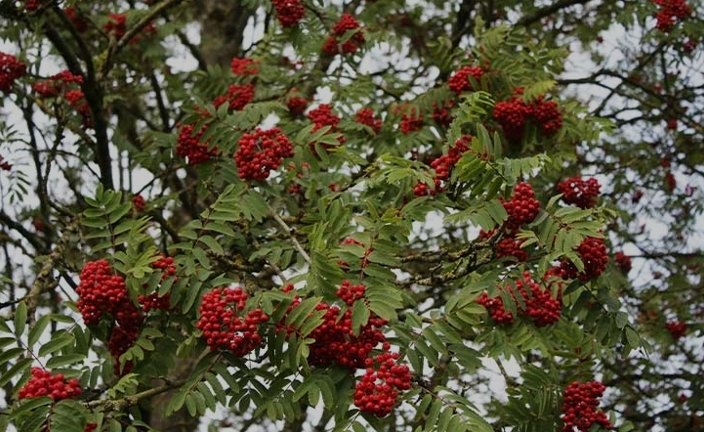
Where to find rowan – Native to cooler regions of the northern hemisphere and most common in the UK in the north and west, it often grows in high-altitude locations. It is commonly found in the wild, particularly in the highlands of Scotland, but it is also widely planted as a street or garden tree.
Did you know? – Rowan is also known as the mountain ash since it grows well at high altitudes and its leaves are similar to those of ash, Fraxinus excelsior. However, the two species are not related. Its old Celtic name, ‘fid na ndruad’, means wizards’ tree.
Value to wildlife – The leaves are eaten by the caterpillars of a number of moths, including the larger Welsh wave and autumn green carpet. Caterpillars of the apple fruit moth feed on the berries.
Flowers provide pollen and nectar for bees and other pollinating insects, while the berries are a rich source of autumn food for birds, especially the blackbird, mistle thrush, redstart, redwing, song thrush, fieldfare and waxwing.
Mythology and symbolism – Rowan was once widely planted by houses as a protection against witches. The colour red was the best colour for fighting evil, and so the rowan’s bright red berries have been associated with magic and witches. In Ireland, it was planted near houses to protect them against spirits, and in Wales rowan trees were planted in churchyards. Cutting down a rowan was considered taboo in Scotland. The wood was used for stirring milk to prevent the milk curdling, and as a pocket charm against rheumatism. It was also used to make divining rods.
Uses of rowan – The wood is pale yellow brown with a deeper-brown heartwood. It is strong, hard, and tough, but not particularly durable. It is sometimes used in turnery, furniture, craftwork, and engraving.
Rowan berries are edible to humans when cooked – they are sour but rich in vitamin C and can be used to make a tart jam.
Threats and conservation- Rowan can be susceptible to fireblight, European mountain ash ringspot-associated virus and silver leaf disease. It can also suffer from browsing by deer.