
One of our most beloved trees. Ash is one of the most common trees in the UK, but as ash dieback sweeps through, is it set to be erased from our countryside?
When fully grown, ash trees can reach a height of 35m. Tall and graceful, they often grow together, forming a domed canopy. The bark is pale brown to grey and fissures as the tree ages. The tree is easily identified in winter by its smooth twigs that have distinctive black, velvety leaf buds arranged opposite each other.
Look out for: the black buds and clusters of seeds which are key features.
Identified in winter by its distinctive black buds and flattened twigs.
Leaves – Pinnately compound, typically comprising 3–6 opposite pairs of light green, oval leaflets with tips up to 40cm long. There is an additional singular ‘terminal’ leaflet at the end. The leaves can move in the direction of sunlight, and sometimes the whole crown of the tree may lean in the direction of the sun. Another characteristic of Ash leaves is that they fall when they are still green.
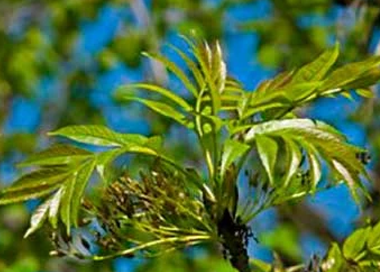
Flowers – Ash is dioecious, meaning that male and female flowers typically grow on different trees, although a single tree can also have male and female flowers on different branches. Both male and female flowers are purple and appear before the leaves in spring, growing in spiked clusters at the tips of twigs.
Fruits – Once the female flowers have been pollinated by wind, they develop into conspicuous winged fruits, or ‘keys’, in late summer and autumn. They fall from the tree in winter and early spring and are dispersed by birds and mammals.
Where to find ash – Ash thrives best in fertile, deep, and well-drained soil in cool atmospheres. It is native to Europe, Asia Minor and Africa and is also found from the Arctic Circle to Turkey. It is the third most common tree in Britain.
Value to wildlife – Ash trees make the perfect habitat for several different species of wildlife. The airy canopy and early leaf fall allow sunlight to reach the woodland floor, providing optimum conditions for wild flowers such as dog violet, wildgarlic and dog’s mercury. In turn, these support a range of insects such as the rare and threatened high brown fritillary butterfly.
Bullfinches eat the seeds and woodpeckers, owls, redstarts and nuthatches use the trees for nesting. Because the trees are so long lived, they support deadwood specialists such as the lesser stag beetle. Ash is regularly accompanied by a hazel understorey, providing the ideal conditions for dormice.
Ash bark is often covered with lichens and mosses. The leaves are an important food plant for the caterpillars of many species of moth, including the coronet, brick, centre-barred sallow and privet hawk-moth.
Mythology and symbolism – The ash tree was thought to have medicinal and mystical properties and the wood was burned to ward off evil spirits. In Norse mythology, ash was the ‘Tree of Life’ and the first man on Earth was said to have come from an ash tree. Even today it is sometimes known as the ‘Venus of the woods’. In Britain, druids regarded the ash as sacred, and their wands were often made of ash because of its straight grain. It has also been noted that, after the Hawthorn, the Ash is the second most widely used tree for planting beside a holy well. In Symbolism of this parallels Norse myth, with the ash drawing its wisdom from the water as Yggdrasil does from the well of Urd. The fact that the tree produces seed pods that are roughly key shaped has also contributed to its association with opening doors to wisdom.
Uses of ash – People have worked with ash timber for years. It is one of the toughest hardwoods and absorbs shocks without splintering. It is the wood of choice for making tools and sport handles, including hammers, axes, spades, hockey sticks and oars. An attractive wood, it is also prized for furniture.
The young, green, immature seeds of ash are edible and have also been used in herbal medicine.
In the 19th century ash was commonly used to construct carriages, and Britain’s Morgan Motor Company still grows ash to make the frames for its cars.
Ash trees can live to a grand old age of 400 years – even longer if coppiced, the stems traditionally providing wood for firewood and charcoal.
Threats and conservation – The main threat to ash trees is ash dieback, also known as Chalara dieback. This is a disease caused by a fungus called Hymenoscyphus fraxineus (previously Chalara fraxinea).
Ash dieback causes trees to lose their leaves and the crown to die back, and usually results in their death. It is thought that tens of thousands of ash trees will die, potentially changing the UK landscape forever.