
The ruling majesty of the woods, the wise old English oak holds a special place in our culture, history, and hearts. It supports more life than any other native tree species in the UK, even its fallen leaves support biodiversity.
A large, deciduous tree growing up to 20–40m tall. Also known as common oak, this species grows and matures to form a broad and spreading crown with sturdy branches beneath.
Look out for: its distinctive round-lobed leaves with short leaf stalks (petioles).
Identified in winter by rounded buds in clusters. Each bud has more than three scales.
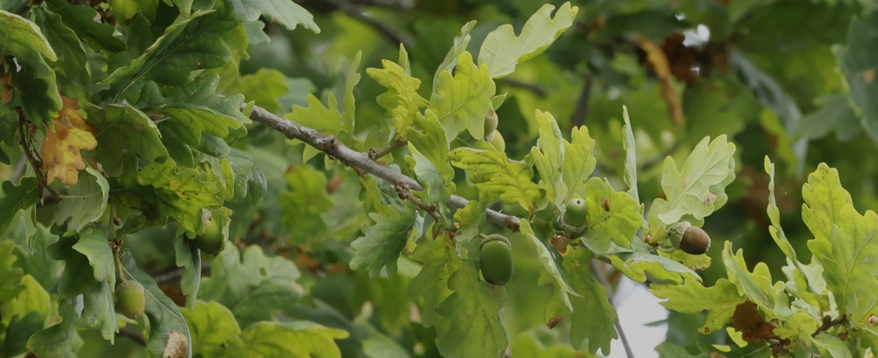
Leaves- Around 10cm long with 4–5 deep lobes with smooth edges. Leaf-burst occurs mid-May and the leaves have almost no stem and grow in bunches.
Flowers – Long, yellow hanging catkins which distribute pollen into the air.
Fruits – Acorns are 2–2.5cm long, on long stalks and in cupules (the cup-shaped base of the acorn). As it ripens, the green acorn turns brown, loosens from the cupule and falls to the canopy below, sprouting the following spring.
Where to find English oak – English oak is a very common tree. It is especially common in deciduous woods in southern and central Britain. In fact, it’s so frequent that it has assumed the status of a national emblem.
Did you know? – Oak trees in the UK can support more than 2,300 different species. While you won’t find that number on a single tree, it does mean oak is associated with a greater biodiversity than any other native tree.
Most acorns will never get the chance to germinate as they are a rich food source, eaten by many wild creatures, including jays, mice and squirrels.
Value to wildlife – Oak forests support more life forms than any other native forest. They are host to hundreds of insect species, supplying many birds with an important food source. In autumn, mammals such as squirrels, badgers and deer feed on acorns.
Flower and leaf buds of English oak are the food plants of the caterpillars of purple hairstreak butterflies.
The soft leaves of English oaks break down with ease in autumn and form a rich leaf mould beneath the tree, supporting invertebrates such as the stag beetle, and fungi, like the oakbug milkcap. Holes and crevices in the tree bark are perfect nesting spots for the pied flycatcher, redstart or marsh tit.
Bats also roost in old woodpecker holes or under loose bark, as well as feeding on the rich supply of insects in the tree canopy..
Mythology and symbolism – The oak was sacred to many gods, including Zeus, Jupiter, and the Celtic Dagda. Each of these gods ruled over thunder and lightning, and oak trees are often hit by lightning as they are the tallest living feature in the landscape.
Druids (whose name means ‘Oak Wisdom”) practised rituals in oak groves and cherished the mistletoe that grows in oak-tree branches. It’s also linked with royalty: ancient kings and Roman Emperors wore crowns of oak leaves.
In England, the oak is a national symbol of strength. Couples were wed under ancient oaks in Oliver Cromwell’s time. Oak is the emblem of many environmental groups, including the Woodland Trust. In English folklore, the oak tree is deeply symbolic of strength, wisdom, and longevity, and is often associated with royalty and the divine. It’s been considered sacred by various cultures, including the Celts and the Romans, and is linked to gods of thunder and lightning like Zeus, Jupiter, and Thor. The oak also features prominently in tales of the Oak King and Holly King, representing the changing seasons.
Uses of English oak – Oaks produce one of the hardest and most durable timbers on the planet. However, it takes up to 150 years before an oak is ready to use in construction. It has been a prized hardwood timber for thousands of years and is still used for flooring, wine barrels and firewood.
Other uses of oak: Leaves, bark and acorns were believed to heal many medical ailments, including diarrhoea, inflammation and kidney stones. Acorns have also been used to make flour for bread making. Tannin found in the bark has been used to tan leather since at least Roman times.
Threats and conservation – Acute oak decline and chronic oak decline are serious conditions affecting Britain’s oaks, with several contributing factors linked to the diseases. Decline of mature oaks first aroused concern in the 1920s and today most cases are in central, southern and eastern England.
The oak processionary moth is a non-native pest that has been found in London, Surrey and Berkshire. Not only does it damage the foliage of the trees and increase the oak’s susceptibility to other diseases, but it is also actually a risk to human health. The moth’s hairs are toxic and can lead to itching and respiratory problems.