
Charming, sturdy, pollinator-magnet. Not only does the small-leaved lime’s blossom produce a sweet scent and pleasantly minty honey, but its leaves also support the caterpillars of moths such as the lime hawk, peppered and vapourer.
Small-leaved lime, this is because it’s potentially tolerant to a warming climate due to its deep roots which can access water and nutrients lower down. It’s also resistant to greys squirrel damage.
This large deciduous tree can grow to more than 20m high. Its bark is grey-brown and smooth and develops flaky plates with age. The twigs are brown-red in the shade, but become shiny in sunlight. Small-leaved lime may produce suckers from the base of the tree.
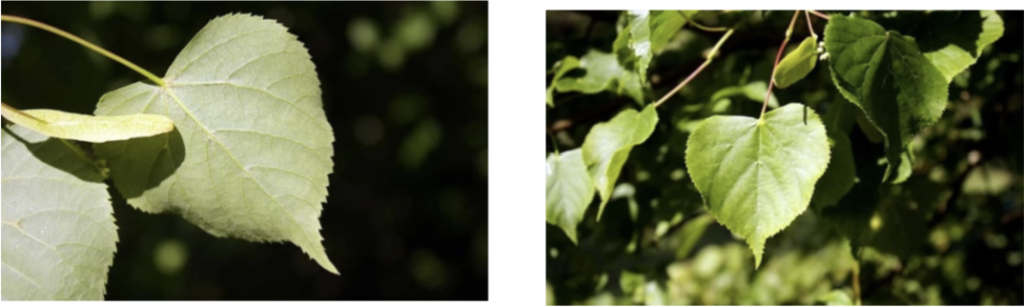
Look out for: the heart shaped leaves which have rusty red hairs where the leaf stalk attaches to the twig. Identified in winter by: the twigs, which look red on top and more olive green underneath. The smooth, shiny red buds are shorter than 4mm and have only 2–3 scales.
Leaves – Heart-shaped with a pointed tip, 3–8cm in length, and hairless except for reddish to brown tufts on the underside of the vein-joints.
Flowers- Limes are hermaphrodite, meaning both male and female reproductive parts are contained within each flower. Flowers are green-yellow, have five petals, and hang in clusters of 4–10. They have a rich, heavy scent which attracts many insects, particularly bees.
Fruits – Once pollinated by insects, flowers develop into round-to-oval, smooth fruits with pointed tips.
Native to much of Europe and Britain it is found in woodland and grows best on moist but well-drained nutrient-rich soils. Once a dominant woodland species, it is now rare in woods, and in some English regions it is considered an indicator species of ancient woodland.
Did you know? – Lime trees were often planted along roads by royal decree to get good luck in harvests. Lime-flower tea, made from the dried blossom, has a pleasing taste, due to the aromatic oil found in the flowers.
Value to wildlife
Lime leaves are eaten by the caterpillars of many moth species, including the lime hawk, peppered, vapourer, triangle and scarce hook-tip moths. They are very attractive to aphids, providing a source of food for their predators, including hoverflies, ladybirds and many species of bird. The flowers provide nectar and pollen for insects, particularly bees, which also drink aphid honeydew from lime leaves. Long-lived trees provide dead wood for wood-boring beetles, and nesting holes for birds.
Mythology and symbolism – Limes appear in folklore across Europe. They are often associated with fertility, especially in Estonia and Lithuania. It’s also considered a sacred tree in Slavic mythology and German folklore where it also represented fairness and justice. It has been associated with romance and lovers and the tree was often used as a symbol in romantic poetry. In France and Switzerland, limes represent liberty, and the trees were planted to celebrate different battles. It was also said that sitting under a lime tree would cure epilepsy.
Uses of small-leaved lime
Lime wood is soft and light, white-yellow and finely textured. It is easy to work and used in turnery, carving and furniture-making. Lime bark was traditionally used to make rope.
The wood is still used today to make sounding boards and piano keys as it doesn’t warp. The flowers were used to make tea, especially during the Second World War when leaf tea was hard to come by. The tree’s sweet sap was made into wine. The flowers were valued for their medicinal properties and they were considered an effective treatment for insomnia, headaches and other ‘nervous’ disorders.
Threats and conservation – Lime trees may be susceptible to fungal disease, which can cause root rot and bleeding cankers. Trees can also suffer infestations of aphids, sap-sucking insects and gall mites, including the nail gall, and are occasionally affected by wilt, which can be fatal.