
Ancient, morbid, toxic. The yew is one of the longest-lived native species in Europe. This has made it a symbol of death and doom, but it provides food and shelter for woodland animals.
Mature yew trees can grow to 20m. The bark is reddish-brown with purple tones, and peeling. The yew is probably the most long-lived tree in northern Europe.
Look out for: the needle-like leaves which grow in two rows along a twig. Underneath, the needles each have a raised central vein.
Identified in winter by: its evergreen needle-like leaves which are present all year round
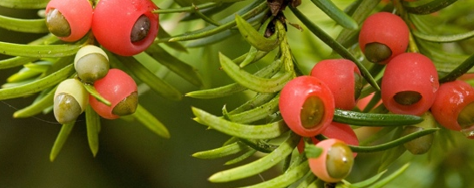
Leaves – Straight, small needles with a pointed tip, coloured dark green above and green grey below. They grow in two rows on either side of each twig.
Flowers – Yew is dioecious, meaning that male and female flowers grow on separate trees. These are visible in March and April. Male flowers are insignificant white-yellow globe-like structures. Female flowers are bud-like and scaly, and green when young but becoming brown and acorn-like with age.
Where to find yew – Yew is commonly found growing in southern England and often forms the understorey in beech woodland. It can be used as a hedging plant and is common in churchyards.
The association with immortality could have come about because of the evergreen foliage or because of the yew’s amazing ability to renew itself. They can return to life from apparent decay.
Value to wildlife – Yew hedges are incredibly dense, offering protection and nesting opportunities for many birds. The goldcrest and firecrest nest in broadleaf woodland with yew understoreys.
Did you know? -The Romans believed that yews grew in hell- The yew is incredibly long-lived and is not considered ancient until it reaches 900 years old. Ten yew trees in Britain are believed to predate the 10th century.
ANCIENT YEW TREES: THE UK’S OLDEST YEWS- With lifespans of up to 3,000 years, the oldest living tree in the UK is easily a yew. Yews have witnessed some monumental moments in our history. A yew was said to have sheltered Robert the Bruce, it was under a yew that the Magna Carta was sealed, and the same yew was also believed to be a meeting place for Henry VIII and Anne Boleyn.
Could a Yew be immortal? – Yews are incredibly long lived – in fact they live for around 900 years before they become ancient. That’s compared to around 400 years for an oak tree. Ancient yews can then expect to go on thriving for thousands of years.
Mythology and symbolism – Yew trees are associated with churchyards and there are at least 500 churchyards in England which contain yew trees older than the buildings themselves. It is not clear why, but it is thought that yew trees were planted on the graves of plague victims to protect and purify the dead, and in churchyards to stop ‘commoners’ from grazing their cattle on church ground as yew is extremely poisonous to livestock.
Uses of Yew – Yew timber is incredibly strong and durable. Traditionally, the wood was used in turnery and to make long bows and tool handles. One of the World’s oldest surviving wooden artefacts is a yew spear head estimated to be around 450,000 years old.
Anti-cancer compounds are harvested from the foliage of Taxus baccata and used in modern medicine. Yew trees contain the highly poisonous taxane alkaloids that have been developed as anti-cancer drugs. Eating just a few leaves can make a small child severely ill and there have been some deaths linked to yew poisoning. While the red, fleshy part of the yew’s fruit isn’t toxic, the seed inside it is poisonous to humans, and so are the bark and leaves.
Yew trees were used as symbols of immortality, but also seen as omens of doom. For many centuries it was the custom for yew branches to be carried on Palm Sunday and at funerals. In Ireland it was said that yew was ‘the coffin of the vine’, as wine barrels were made of yew staves.
Threats and conservation – Yew has a reputation for being indestructible, but it may be susceptible to root rot.